


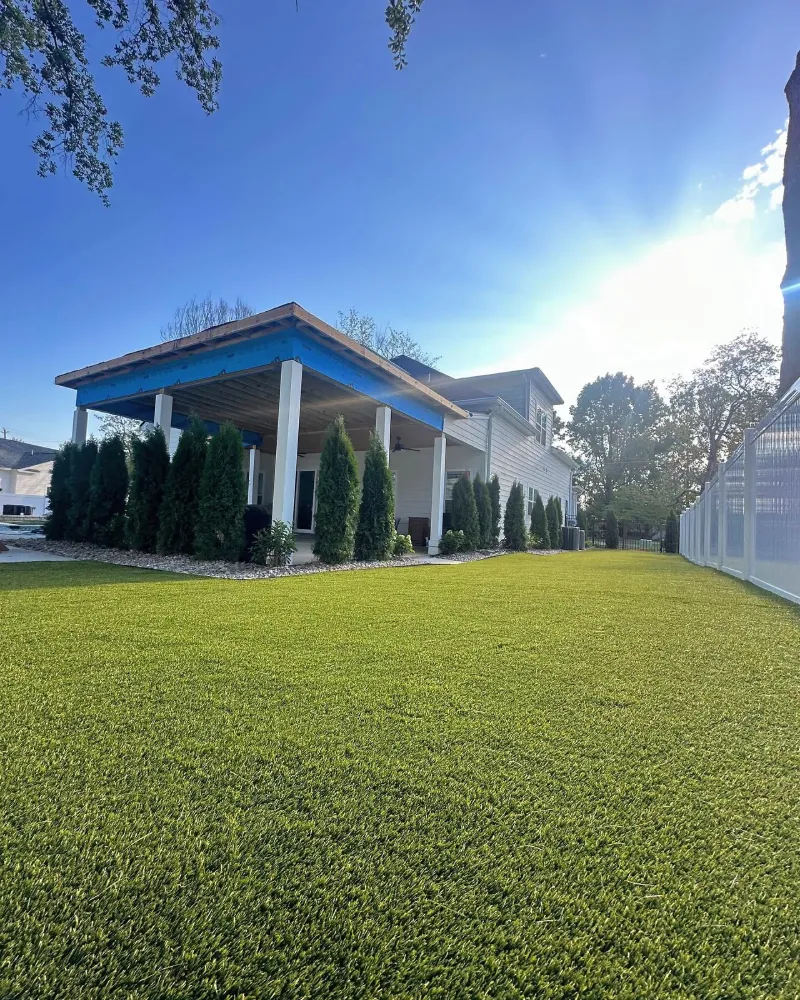
Artificial turf can last about 8 to 15 years, but its expected service life depends on more than just the turf material. Fiber quality, UV resistance, drainage, base construction, traffic, installation quality, and maintenance all influence how long a residential system performs well.
What Determines The Expected Lifespan Of Artificial Turf?
Artificial turf is a system made up of multiple components. The synthetic fibers are only one part of the installation.
The major factors include:
- Fiber quality and UV stabilization
- Sub-base construction
- Drainage design
- Installation quality
- Traffic and usage
- Infill performance
- Routine maintenance
- Local environmental exposure
Beacon Turf states that its installations use heat-rated, UV-stabilized turf, while its products are backed by manufacturer warranties of up to 15 years.
A warranty, however, should not be interpreted as a guaranteed service life. Actual performance depends on how the complete system is designed, installed, used, and maintained.
What Turf Specifications Should Homeowners Compare?
A homeowner should look beyond color, blade height, and initial appearance. Technical specifications can provide more useful information about expected performance.
Fiber Material
The polymer used to manufacture turf fibers affects their resistance to UV exposure, traffic, and repeated compression. Beacon Turf’s published information identifies polyethylene, polypropylene, and nylon as materials used in artificial turf systems, with different performance characteristics.
UV Stabilization
UV stabilizers help synthetic fibers resist degradation caused by prolonged sunlight exposure.
UV stabilization:
A manufacturing treatment designed to improve resistance to ultraviolet radiation and help preserve fiber performance and color.
Face Weight
Face weight:
The weight of turf fibers per square yard, excluding the backing. Higher face weight can contribute to a denser surface, but it should not be evaluated independently from fiber quality, backing, infill, and installation.
Tuft Bind Strength
Tuft bind strength:
The force required to pull an individual turf fiber from its backing. Stronger fiber attachment can help resist mechanical stress and repeated use.
Permeability
Permeability:
The rate at which water moves through the turf system. Adequate permeability is particularly important in areas exposed to substantial rainfall.
Why Does The Base Matter As Much As The Turf?
A high-quality turf product cannot compensate for an improperly constructed foundation.
The sub-base supports the surface, influences drainage, and helps prevent movement, depressions, and uneven areas. Beacon Turf describes its installation process as including excavation, compaction of a crushed-stone sub-base, and slope grading before turf installation.
Poor base preparation can contribute to:
- Sinking
- Wrinkling
- Uneven surfaces
- Soft spots
- Drainage problems
- Premature seam or edge problems
This is why homeowners comparing artificial turf in Tampa should evaluate installation methodology alongside the turf manufacturer’s specifications.
How Important Is Drainage To Turf Longevity?
Drainage is particularly important in climates that experience heavy rainfall.
Water needs to move efficiently through the turf and underlying base rather than remaining trapped beneath the surface. Beacon Turf specifically notes that Tampa installations require drainage considerations for heavy rainfall and that its approach includes site-specific grading and drainage layers.
Poor drainage can contribute to:
- Saturated base materials
- Loss of structural stability
- Surface depressions
- Infill movement
- Persistent moisture
- Odor or organic buildup
Homeowners should therefore ask how water will move through the completed installation before choosing a turf product.
Does Foot Traffic Shorten the Lifespan of Artificial Turf?
Yes. Usage intensity and traffic patterns influence wear.
A lawn used occasionally for decorative purposes will generally experience different stresses from one used daily by children, pets, or frequent gatherings.
High-use areas can develop:
- Flattened fibers
- Uneven infill
- Visible traffic paths
- Increased surface wear
- Localized matting
For artificial turf in Tampa, FL, the important issue is not simply the number of people using the lawn. Repeated traffic concentrated in the same locations can accelerate wear more quickly than evenly distributed use.
How Does Maintenance Affect Service Life?
Artificial turf is low-maintenance, but it is not maintenance-free.
Routine care can help preserve fiber appearance, maintain infill distribution, and identify drainage or seam problems before they become more serious.
Basic Maintenance Checklist
- Remove leaves and organic debris.
- Brush high-use areas periodically.
- Monitor infill levels.
- Check seams and edges.
- Watch for areas that drain slowly.
- Remove spills and contaminants promptly.
- Address localized wear before it spreads.
Beacon Turf’s published lifespan guidance identifies maintenance consistency as one of the important factors affecting long-term performance.
For homeowners in Hyde Park, establishing a simple maintenance routine can help preserve the installation between professional inspections or service visits.
Does A Longer Warranty Mean Better Turf?
Not necessarily.
A longer warranty can be useful, but homeowners should understand what the warranty actually covers and under what conditions.
Before choosing a system, ask:
| Question | Why It Matters |
| How long is the manufacturer warranty? | Establishes the stated coverage period |
| What defects are covered? | Not every type of wear may qualify |
| Is fading covered? | Important for sunny outdoor areas |
| Are installation defects covered? | Separates material from workmanship |
| Is the warranty transferable? | Useful if the home is sold |
| What maintenance is required? | Failure to follow requirements may affect coverage |
Beacon Turf states that its manufacturer-backed turf products have warranties of up to 15 years and that installation documentation is maintained for warranty purposes.
How Should Homeowners Compare Turf Systems?
Instead of asking, “How many years will this turf last?” homeowners should evaluate the entire system.
A Better Evaluation Framework
Material:
What fibers, backing, and UV stabilization are used?
Installation:
How will the existing soil be excavated, graded, and compacted?
Drainage:
How will the system handle normal and heavy rainfall?
Usage:
Will the lawn be decorative, recreational, pet-focused, or heavily trafficked?
Maintenance:
What routine care will be required?
Warranty:
What does the manufacturer actually guarantee?
Lifecycle value:
Will a higher-quality installation reduce the likelihood of premature repairs or replacement?
This approach provides more useful information than comparing turf samples based solely on appearance.
Does Tampa’s Climate Affect Artificial Turf Lifespan?
Climate should be part of the evaluation because outdoor turf is exposed to sunlight, heat, humidity, and rainfall.
UV radiation can gradually affect synthetic polymers, while heat cycles create repeated expansion and contraction. Heavy rainfall also places greater demands on the drainage and base system. Beacon Turf specifically identifies UV exposure, heat cycles, rainfall, and windborne debris as environmental stressors affecting turf longevity.
A properly engineered system should account for these conditions during material selection and installation.
For homeowners in West Tampa, evaluating drainage and UV resistance alongside appearance can provide a better indication of long-term suitability.
A Common Myth About Artificial Turf Lifespan
Myth: Artificial Turf Is Install-And-Forget
Artificial turf eliminates many routine lawn-care tasks associated with natural grass, but it still requires maintenance.
Fibers can flatten, infill can move, debris can accumulate, and drainage performance can change over time. Beacon Turf specifically identifies brushing, debris removal, infill management, and inspection of seams, edges, and drainage as components of a structured maintenance approach.
An expectation of maintenance-free operation can therefore lead to premature deterioration.
How Can Homeowners Maximize Turf Service Life?
The most effective strategy is to address longevity during the planning stage rather than waiting for problems to appear.
Before Installation
- Choose turf appropriate for the intended use.
- Verify UV stabilization and material specifications.
- Ask about the backing and infill system.
- Review the manufacturer’s warranty.
- Understand the proposed drainage design.
- Ask how the sub-base will be prepared.
- Confirm what maintenance will be required.
After Installation
- Keep the surface free from debris.
- Monitor high-traffic areas.
- Maintain appropriate infill levels.
- Inspect seams and edges.
- Watch for drainage changes.
- Schedule maintenance when needed.
The objective is to maintain both the visible surface and the structural system underneath it.
Is Higher-Quality Artificial Turf Worth The Investment?
Potentially, particularly when the lawn will be exposed to substantial sunlight, rainfall, or regular use.
The cheapest installation is not necessarily the lowest-cost option over its entire service life. Premature fading, drainage problems, uneven surfaces, or fiber deterioration can lead to repair or replacement expenses.
Beacon Turf emphasizes installation engineering, site-specific drainage, UV-stabilized materials, and manufacturer-backed warranties as parts of its approach.
For homeowners comparing Tampa artificial turf options, the better question is not simply which option costs less today, but which system is most likely to deliver reliable performance throughout its expected service life.
Final Takeaway
Homeowners should evaluate the lifespan of artificial turf by considering fiber quality, UV stabilization, base construction, drainage, installation quality, usage, infill, maintenance, and warranty coverage. A typical installation can last approximately 8 to 15 years, but actual performance varies according to environmental conditions and how the system is designed and maintained.
Beacon Turf states that its turf products are backed by manufacturer warranties of up to 15 years and that its installations are engineered around site-specific drainage and sub-base requirements.
Contact Us to discuss your yard, expected usage, drainage requirements, and the artificial turf system that best fits your long-term landscaping goals.
People Also Ask
How Long Does Artificial Turf Usually Last?
Artificial turf installations typically last 8 to 15 years, although material quality, installation, climate, traffic, and maintenance can push actual performance outside that range.
What Makes Artificial Turf Last Longer?
Quality fibers, UV stabilization, proper base construction, effective drainage, appropriate infill, professional installation, and consistent maintenance can all contribute to longer service life.
Does Heavy Rain Damage Artificial Turf?
Heavy rain does not inherently damage properly engineered turf, but inadequate drainage can create problems with the base, infill, and surface stability.
Is Artificial Turf Maintenance-Free?
No. It requires less routine care than natural grass but still benefits from debris removal, brushing, infill management, and periodic inspection.